Mt. Lady Macdonald ex-Teahouse site Trail hike on 3-Jun-2026
Participants: Leslie, David, Barbara
On June 3, 2026, I had planned to hike up Ha Ling peak, near Canmore, Alberta. It is relatively short—about 3.9 km one-way distance to the summit—and has a fairly significant elevation gain of about 810 m. From the summit, there is a panoramic view of the Bow Valley. However, my plans were quashed when Canmore experienced a significant rain event and was pounded by up to 100 mm of rain over a few days. The non-stop pummeling saturated the area and created a sudden landslide on Monday evening, June 1, from the East End of Rundle. Large boulders slammed into the Smith-Dorrien Highway/Spray Lakes Road and deposited waist-deep rocks into the steep, gravel road. The event forced a road closure between the Grassi Lakes parking area and the Goat Creek Day Use area, which is the trailhead for Ha Ling. Clearly, my plans for hiking up Ha Ling were obliterated along with the roadway.
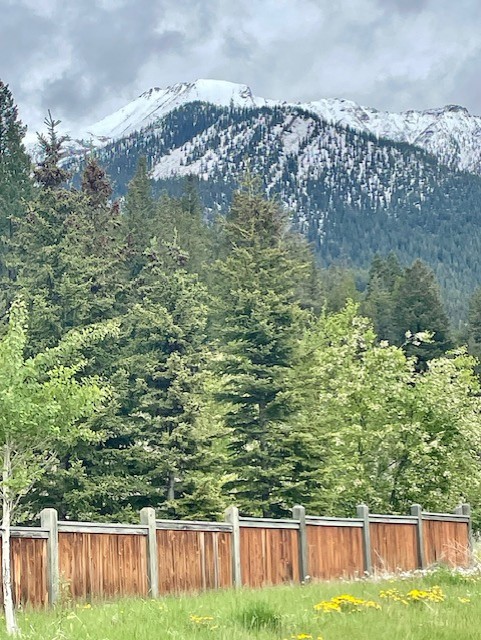
After discussing the issue with another Rambler, I decided to offer a hike up Mount Lady MacDonald, which is located on the north side of Canmore. This peak is a steep, unrelenting climb but it is south-facing, and so rain and snowfall melts relatively quickly. Lady Mac, as it is colloquially known, has two major objectives: the summit or the heli-pad. The summit, which I had done when I was younger, is a knife-edge ridge and involves about a 1,200 to 1,325 m elevation gain and a round trip of about 10 to 12 km. On the other hand, the helipad entailed about 900 to 1,000 m of elevation gain and was about 8 to 9 km return.
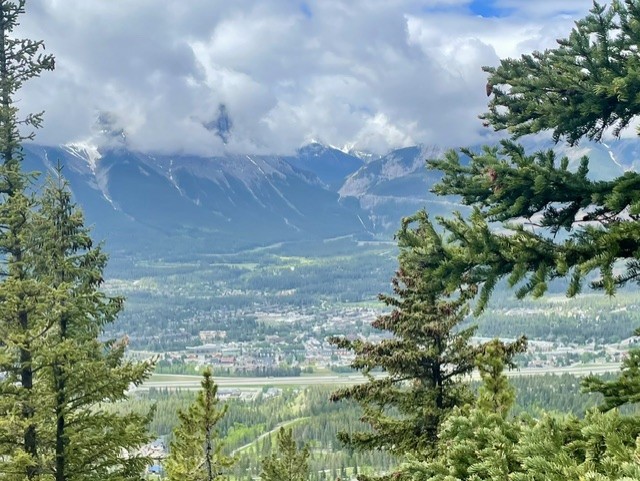
Given that the helipad was shorter and had less elevation gain, we decided to give it a try. The helipad was built in the mid-1980s and was part of an initiative to build a luxurious mountain teahouse, where visitors could enjoy panoramic views of the Bow Valley. However, the project faced major opposition from residents in the Bow Valley due to concerns over noise pollution from the helicopter. The project finally folded by 2002. The partially built teahouse and wooden heli-pad platform was taken apart over the years and by 2022, it was completely demolished. Although the teahouse and helipad are now non-existent, hikers still hike up to the old platform.
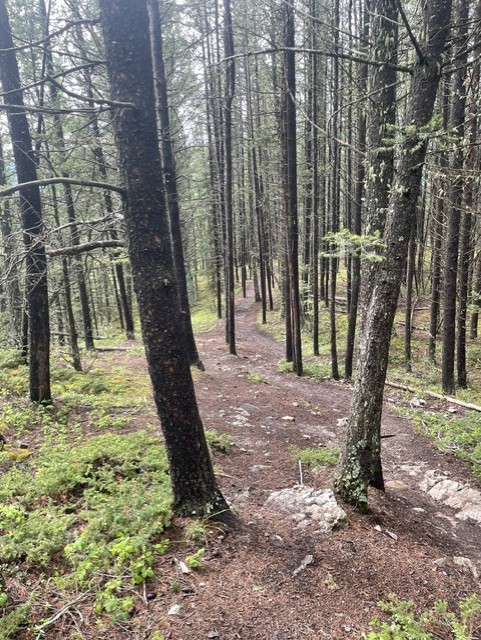
Although we had a group of six for Ha Ling, fewer people were interested in Lady Mac, and so our group of six dwindled to three: Dave, Barb, and me. When we met at Cougar Creek, which is the trailhead for Lady Mac, we had a relatively good look at the mountain, and it was obvious that there was quite a lot of snow at higher elevations. Above 2,000 m, peaks in the Canmore area had received about 15 cm of heavy, wet snow in the previous few days. However, starting on the valley bottom, the walk along Cougar Creek was completely dry. When we left the creek to ascend the peak, the trail was also in good condition--fairly dry with only a few patches of snow here and there.
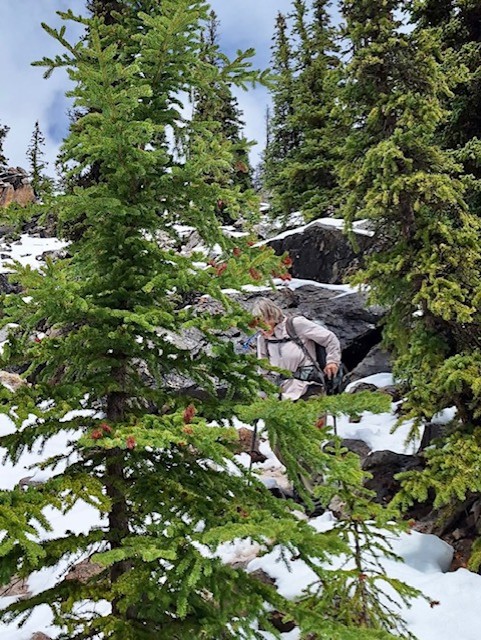
However, as we gained elevation, the small patches of snow gave way to deeper and more widespread clumps of the white stuff. I started to wonder whether we would end up post-holing through the snow to get to the helipad. It wasn’t an attractive possibility. In addition, as I am now in my seventies, I like to hike at a slower pace and take time to enjoy the scenery. I was finding it difficult to keep up to the faster members in the group, and so I suggested that I stay back, while Barb and Dave pushed up to the helipad.
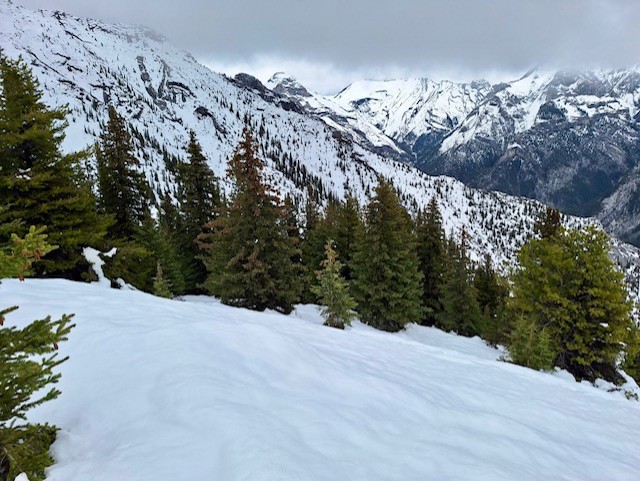
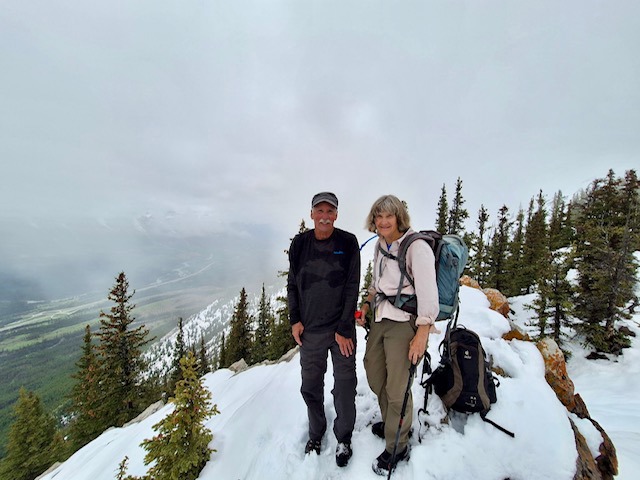
Later, Dave explained how the snow “got deeper, and the hill got steeper and slippery.” He and Barb stopped just shy of the top and found only one set of tracks in the snow, although we had seen several hikers on the trail. Dave thought there was about two feet of snow at the “top.” However, on the positive side, it was sunny and about 20 degrees C, so they were able to relax and enjoy the outstanding views.
On the hike back down, I took time to enjoy the trail and the magnificent mountain surroundings. Views of Cougar Creek emerged through the open spots, and the clouds funneling upwards created a moody atmosphere.
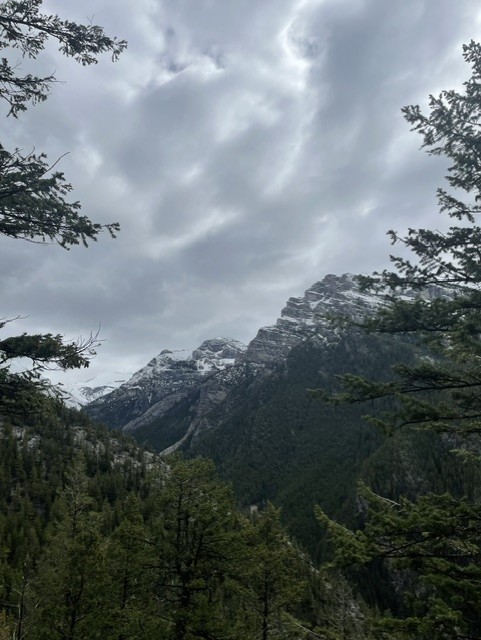
Towards the end of the trail, I could clearly see the Cougar Creek Dam, which was built after the catastrophic 2013 floods. In this unprecedented weather event, a slow-moving storm remained in the valley for about three days, dumping about 25 cm of rain and triggering a rapid snowmelt. Cougar Creek, normally a small, gurgling stream, turned into a devastating torrent that carried large boulders and whole trees down the valley. The flood damaged over 40 homes, destroyed municipal infrastructure, and forced 1,200 residents to evacuate. In response, the Cougar Creek Debris Flood Retention Structure was built, in order to mitigate the damage of any future floods.
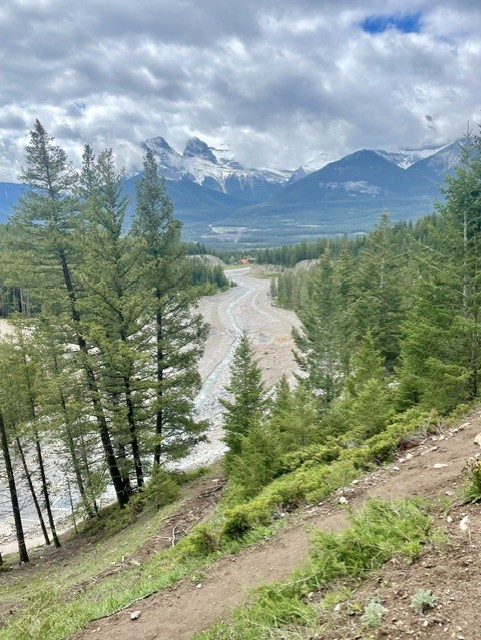
The 2013 floods, and the subsequent building of the Cougar Creek dam has altered the lower section of the trail up Lady Mac, while the upper sections remain the same.
Many thanks to Barb and Dave for joining me, Leslie (c/s) on this trip, and thanks also to Dave for contributing photos.